
α-Polyglutamic Acid (α-PGA): Structure, Synthesis, and Advanced Applications
Published: 2026 | Category: Biomaterials & Polymer Science | Tag: α-PGA, Polyglutamic Acid, Biodegradable Polymer, Drug Delivery
Introduction
With the rapid development of green biomaterials and regenerative medicine, synthetic polyamino acids have become one of the most popular high-performance biomedical materials. Among them, α-Polyglutamic Acid (α-PGA) stands out for its regular molecular structure, excellent biocompatibility, complete biodegradability, and controllable molecular weight.
Different from natural γ-PGA produced by microbial fermentation, α-PGA is a chemically synthesized ordered polymer. It has irreplaceable advantages in high-end fields such as targeted drug delivery, tissue engineering, and medical skincare. This article comprehensively introduces the molecular structure, core synthesis methods, and industrial application scenarios of α-PGA, providing a systematic reference for material research and industrial promotion.
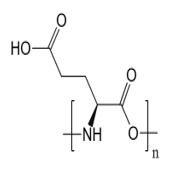
1. Basic Structure and Core Properties of α-PGA
1.1 Chemical Molecular Structure
α-PGA is a linear homopolypeptide formed by the dehydration condensation of L-glutamic acid monomers. Its core structural feature is different from traditional γ-PGA:
α-PGA forms peptide bonds through the α-amino group and α-carboxyl group of glutamic acid, retaining a large number of free γ-carboxyl groups on the side chain. This bonding method makes the main chain of α-PGA extremely regular, which is easy to form a stable α-helix spatial conformation.
Key structural characteristics:
- Standard α-peptide bond: The main chain is stable, with high structural order and good mechanical controllability
- Pure L-configuration: Low immunogenicity, no rejection reaction in human body
- Controllable molecular weight: Stable range of 8–40 kDa, narrow molecular weight distribution
- Rich active side chains: A large number of free carboxyl groups, which can be cross-linked, esterified and modified functionally
1.2 Physical and Biological Properties
α-PGA has excellent comprehensive properties, which determine its high-end application value:
- Super water solubility: The anionic carboxyl group on the side chain makes it have strong hydrophilicity, stable in neutral and weak acidic environment
- Full biodegradability: The degradation product is natural L-glutamic acid, non-toxic and harmless to human body and environment
- Excellent biocompatibility: No inflammation, no immune rejection, suitable for long-term in vivo implantation
- Easy functional modification: It can be prepared into hydrogel, microspheres, nanofibers and other composite materials
2. Main Synthesis Methods of α-PGA
It is worth noting that α-PGA cannot be synthesized by microbial fermentation (microorganisms only produce γ-PGA). At present, all high-purity medical-grade α-PGA is prepared by chemical synthesis, among which NCA ring-opening polymerization is the mainstream industrial technology.
2.1 Core Technology: NCA Ring-Opening Polymerization
This method has the advantages of controllable molecular weight, high purity and large-scale production, and is the first choice for commercial α-PGA preparation.
Step 1: Preparation of glutamic acid NCA monomer
L-glutamic acid is used as the raw material, and the γ-carboxyl group is protected by tert-butyl esterification. Then it reacts with bisphosgene to generate stable γ-tert-butyl-L-glutamic acid NCA monomer, which is purified to remove impurities to ensure polymerization activity.
Step 2: Controlled ring-opening polymerization
Under anhydrous and oxygen-free conditions, amine initiators are used to trigger NCA monomer ring-opening polymerization in organic solvents. The molecular weight of α-PGA can be accurately controlled by adjusting the ratio of monomer to initiator, and the product has a very low dispersion coefficient (PDI < 1.2).
Step 3: Deprotection and purification
Trifluoroacetic acid (TFA) is used to remove the tert-butyl protective group, and high-purity α-PGA is obtained after dialysis and freeze-drying, with a total yield of more than 85%.
2.2 Auxiliary Synthesis Methods
- Solid-phase peptide synthesis: It can prepare ultra-high-purity short-chain α-PGA, but the cost is high and the output is low, which is only suitable for precise drug coupling scenarios
- Enzymatic catalytic synthesis: Green and mild reaction conditions, but the product molecular weight is low and the yield is poor, which is still in the laboratory research stage
2.3 Comparison of α-PGA Synthesis Technologies
| Synthesis Method | Advantages | Disadvantages | Application Scenarios |
|---|---|---|---|
| NCA Ring-Opening Polymerization | Controllable molecular weight, high purity, scalable production | Requires anhydrous and anaerobic environment, complex monomer preparation | Industrial & medical grade mainstream products |
| Solid-Phase Synthesis | Ultra-high purity, accurate short-chain structure | High cost, low efficiency, unable to mass produce | Precision drug conjugation, laboratory research |
| Enzymatic Catalysis | Green, environmental-friendly, mild reaction | Low molecular weight, low yield, poor stability | Basic academic research |
3. Advanced Application Fields of α-PGA
Different from γ-PGA which is widely used in agriculture and daily chemical industry, α-PGA is positioned as a high-end biomedical and advanced functional material, with outstanding performance in precision medical and high-end skincare fields.
3.1 Biomedical Field (Core Application)
3.1.1 Targeted Drug Delivery Carrier
α-PGA is the ideal carrier for anti-tumor drugs, protein drugs and polypeptide drugs. The free carboxyl group on its side chain can covalently couple chemotherapy drugs (doxorubicin, paclitaxel) and targeted groups (folic acid, peptides).
It can prepare nano-drugs and prodrugs to realize tumor targeted enrichment, slow release and sustained release, significantly reduce the toxic and side effects of chemotherapy drugs, and improve drug utilization.
3.1.2 Tissue Engineering Scaffold Material
α-PGA can be fabricated into porous hydrogels and electrospun fiber membranes. Its structure simulates the extracellular matrix (ECM) of human tissues, which can effectively promote cell adhesion, proliferation and differentiation.
It is widely used in skin wound repair, bone and cartilage regeneration, nerve tissue engineering. Its degradation rate matches the tissue regeneration cycle, and no secondary surgery is required to remove the material.
3.1.3 Medical Hemostatic and Wound Dressing
α-PGA has excellent moisture retention and exudate absorption capacity. It can maintain a moist wound microenvironment, accelerate wound epithelialization, and has antibacterial and anti-inflammatory effects.
It is suitable for surgical incisions, burn wounds, and chronic refractory ulcers such as diabetic foot ulcers, with safe and mild effect.
3.2 High-End Medical Skincare & Personal Care
α-PGA is a new generation of high-efficiency moisturizing and barrier-repairing raw material. Its moisturizing effect is 5–10 times that of hyaluronic acid. It has excellent film-forming property, which can effectively reduce skin transdermal water loss (TEWL).
Core skincare effects:
- Long-term deep moisturizing
- Repair damaged skin barrier
- Soothe sensitive skin and relieve postoperative redness
- Anti-oxidation and anti-aging, improve skin elasticity
It is widely added in medical beauty repair essence, mask, and sensitive skin care products, with high safety and no irritation.
3.3 Other High-Value Applications
- Medical implant coating: Modify the surface of catheters and artificial joints to improve biocompatibility and prevent thrombosis and inflammation
- Healthcare food additive: Chelate calcium, iron and other mineral elements to promote human mineral absorption and assist in improving osteoporosis and anemia
4. Summary and Future Prospect
As a synthetic bio-based polyamino acid, α-PGA has incomparable structural advantages over traditional γ-PGA, with regular molecular structure, controllable performance, high safety and easy functional modification. It has become a key material in the fields of precision medicine and high-end beauty.
At present, NCA ring-opening polymerization is the most mature industrial preparation technology of α-PGA. In the future, the development of α-PGA will focus on three directions:
- Optimize the green synthesis process to reduce production costs and realize large-scale industrial production
- Develop stimulus-responsive intelligent α-PGA materials (pH/temperature/enzyme response) to realize precise controlled release of drugs
- Accelerate clinical transformation and promote the industrialization of α-PGA-based medical devices and innovative drugs
With the continuous breakthrough of biomaterial technology, α-PGA will surely have broader application prospects in regenerative medicine, targeted therapy and high-end personal care fields.
Keywords: α-PGA, α-Polyglutamic Acid, Biodegradable Polymer, Drug Delivery System, Tissue Engineering, Medical Skincare
Leave a Reply